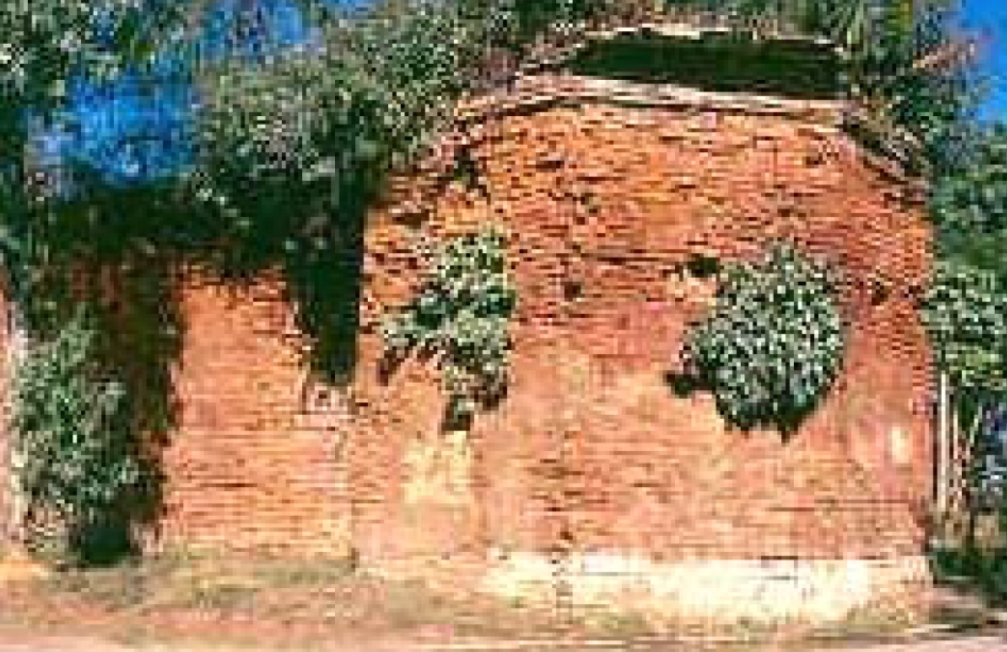
The 2009 findings from the Kangla excavation in Imphal provide compelling archaeological evidence that bricks (“chek” in Meiteilon) were used in the region well before King Khagemba (r. 1597–1652 CE) was born. This challenges popular misconceptions that brick technology and large-scale construction were introduced solely during Khagemba’s reign, often linked to Muslim settlers (Meitei Pangals) arriving from 1606 CE onward or Chinese prisoners captured around 1631–1632 CE.
In the study “Optically stimulated luminescence dating of artifacts excavated from Kangla, Manipur, India” (published in the Indian Journal of Pure & Applied Physics, June 2009), researchers including S.N. Singh (with technical/archaeological support from Nanjest Thongbam) applied the Single Aliquot Regenerative dose (SAR) protocol to quartz grains extracted from pottery and bricks recovered during the 2006 excavations at Kangla Fort.
The equivalent doses (ED) ranged from approximately 1.29–1.47 Gy, yielding ages of roughly 522–595 years before the analysis (accounting for uncertainties and the publication year, this translates to firing events around 1450–1500 CE).
Specific brick samples gave 564 ± 388 years and 595 ± 76 years, firmly placing the last heating/reset of the luminescence clock in the late 15th to early 16th century CE.
These dates correspond directly to the reigns of King Ningthoukhomba (r. 1432–1467 CE) and especially his successor King Senbi Kiyamba (Kyamba or Kiyamba, r. 1467–1508 CE). Khagemba, born to his father King Mungyamba (r. 1562–1597 CE), ascended the throne much later—meaning brick production and use in Manipur predates his birth by 100–150 years or more.
The OSL results apply to fired artifacts (quartz from bricks/pottery reset by kiln heat), not merely depositional sediments, confirming early medieval brick-making in royal or urban contexts during Kiyamba’s era.
Supporting stratigraphic data from the Kangla profile includes Layer K7 (5–7 feet depth): grey-mottled silty sand containing brick fragments, whole bricks, potshards, and weathered red shale, under pluvial conditions with mass wasting (wet/rainy episodes with slope erosion).
No direct OSL date is given for K7, but the cultural inclusions (brick fragments) align with the artifact OSL horizon (~1450–1500 CE), indicating redeposited evidence of early brick activity in the valley’s flood-prone, alluvial setting.
Deeper layers show much older Pleistocene sediment dates (e.g., ~19–27 ka), but these relate to natural burial, not cultural firing events.
The Cheitharol Kumbaba credits King Kiyamba with building the Vishnu Temple at Lamangdong in the late 15th century CE, following his 1470 CE alliance with the Pong (Shan) king, who gifted a Vishnu image.
This led to the site’s renaming as Bishnupur (“abode of Vishnu”). Recognized as one of Manipur’s oldest surviving brick structures (now a protected monument), the temple features small, distinctive bricks, sometimes described as early or partially fired, consistent with pre-Khagemba experimentation.
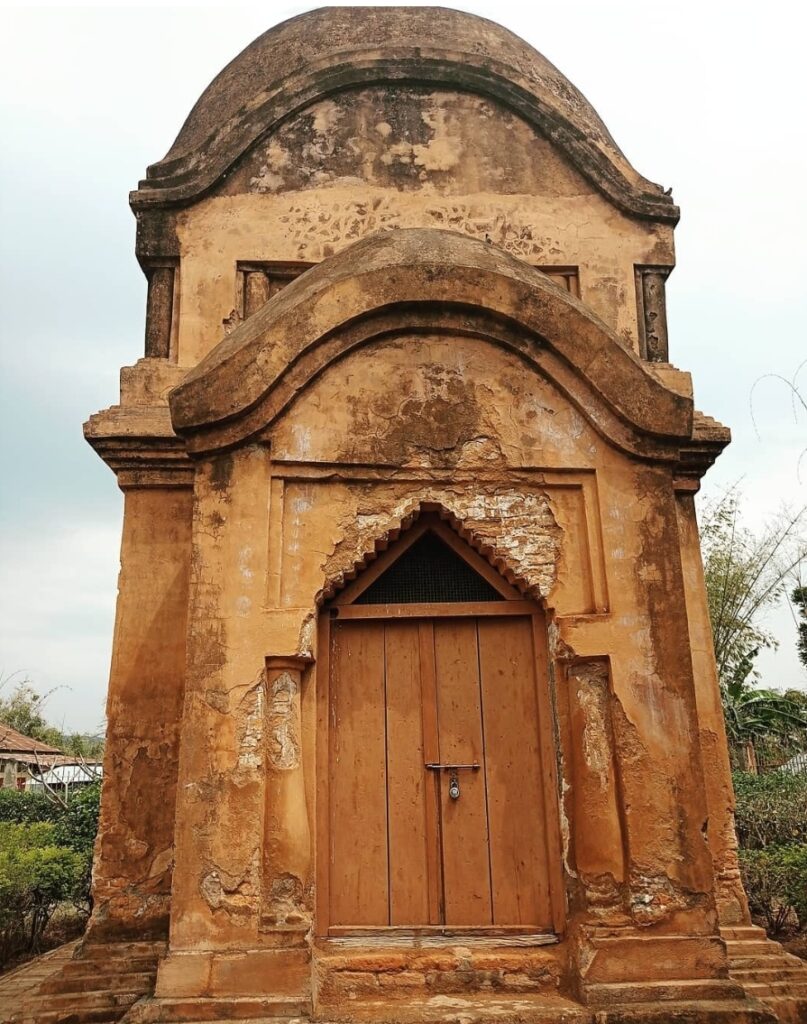
Debate exists with some attribute it to King Charairongba (r. 1697–1709 CE), who promoted Vaishnavism and constructed brick temples (e.g., a Krishna temple in Brahmapur Guru Aribam Leikai, blending Hindu and traditional styles).
However, no clear records link Charairongba to Lamangdong’s Vishnu Temple. Kiyamba’s construction is explicitly chronicled, and the OSL evidence from Kangla supports brick presence by his time.
If Charairongba pioneered brick temples, one would expect similar use in earlier or contemporary structures, but most transitional-period temples relied on wood, bamboo, and thatch, reflecting traditional Meitei architecture before brick became widespread.
This indicates sporadic early brick use under Kiyamba, with limited continuation until revival under later kings.
The Meitei word “chek” for brick exhibits intriguing linguistic parallels that may trace to earlier contacts with Yunnan Province in southwestern China. While modern Mandarin uses zhuān, historical or dialectal pronunciations in southwestern China (influenced by Tibeto-Burman, Tai-Shan, or Yunnan border interactions) have been noted in Manipuri sources as resembling “chek” or similar sounds.
This etymological link could relate to King Kiyamba’s well-documented relationship with the Pong kingdom (a Shan state in present-day Upper Myanmar, bordering Yunnan), through his 1470 CE military alliance, conquest of Khampat in the Kabaw Valley, and the resulting Treaty of 1470 CE—Manipur’s first recorded international agreement. Pong-Shan networks facilitated cross-frontier exchanges of culture, trade, and possibly building techniques or terminology long before the 17th-century Chinese prisoner influx under Khagemba.
Thus, “chek” may represent an early loanword tied to Kiyamba-era eastern connections, symbolizing Manipur’s deep Indo-Myanmar-China frontier ties.
Bricks emerged during Kiyamba’s reign (per Kangla OSL and temple links), likely for select royal/religious purposes amid growing eastern influences (Pong alliance, early Hindu elements). Successive kings showed limited emphasis—constructions stayed predominantly wood-based—until Khagemba prioritized brick for fortifying Kangla’s citadel, including walls and gateways (e.g., western gate in 1632 CE).
His era represented a deliberate expansion, enhanced by captured Chinese (Khagee) prisoners who refined techniques.
King Mungyamba (r. 1562–1597 CE), Khagemba’s father, was a warrior-king who expanded Manipur through campaigns against groups like the Khamrals (capturing firearms in 1584 CE) and border rivals. While mainstream chronicles like the Cheitharol Kumbaba record no direct war with Chinese forces under him, local legends and oral traditions describe a dramatic encounter involving King Piyango of “Khagee Leibak” (often linked to Yunnan/China).
In these stories, popularized in Manipuri folklore, Piyango sends a fierce fighter named Moidana (or Mayadana/Moydana), portrayed as a cannibalistic “hingchaba” demanding human tribute or challenging Mungyamba to single combat in a “fiting battle. Mungyamba accepts, defeats and kills Moidana using his sacred spear “Khangshunaha” and sword “Khoubomba”.
Then the Chinese cannibal was buried under a stone in Kangla. News of the victory reaches Piyango, who visits Meetei Leibak and gifts the Khagee Leihao (Frangipani/Plumeria flower, scientific name Plumeria acuminata), symbolizing peace and cultural ties between Meetei Leibak and Khagee Leibak (Yunnan).
This flower, used in rituals, is seen as a “precious gift from China,” reflecting ancient bonds (some claim Meetei taught silk weaving and Thang Ta to Chinese). These tales, while legendary and not corroborated in the core Cheitharol Kumbaba (which focuses on factual reigns), illustrate perceived frontier interactions and set the stage for later events. They portray Mungyamba as a defender against external threats, contrasting with his son’s documented historical victory.
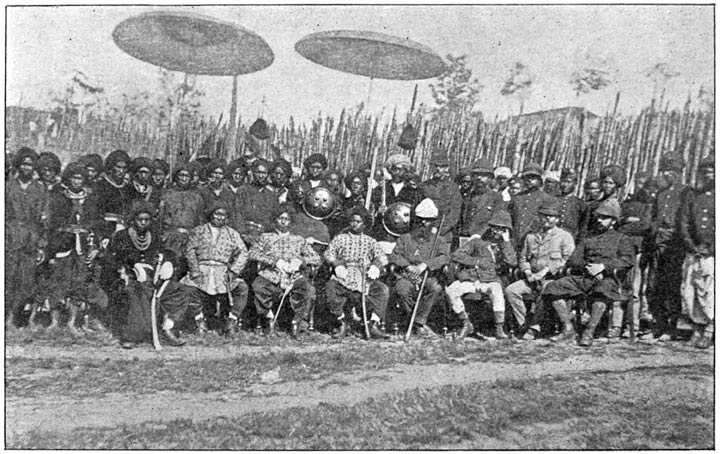
King Khagemba (Ningthou Hanba) earned “Khagemba” (“conqueror of the Chinese”) by defeating invading Khagee forces around 1631 CE at the northern border, repelling what some sources describe as Ming Dynasty expansion after Myanmar conquests.
He captured prisoners, resettled them in places like Suisa Kameng, Chirang, Leimaram, Phayeng, Koutruk, Yimtheng, and others. These Khagee communities integrated, contributing brick-making (“chek”), weaving and crafts, profoundly shaping Manipur’s architecture and economy.
This father-son dynamic shows continuity: Mungyamba’s legendary defense against a “Khagee” challenger (Piyango’s envoy) built prestige, while Khagemba’s real victory brought practical benefits through captives.
Settlements like Suisa Kameng and Chirang preserve traces of these Chinese-descended groups, blending into Meitei society.
A misconception credits Meitei Pangals (Manipuri Muslims, settling from 1606 CE under Khagemba) with introducing bricks. No Pangal surnames tie to brick-making or kilns (e.g., Phusam for Pottery, Chesam for paper-making families), while origins link more to royal initiatives and eastern/Chinese influences.
This, the 2009 Kangla OSL evidence, combined with chronicles, legends, and etymology, shows bricks used in Manipur during Kiyamba’s time (late 15th century CE)—centuries before Khagemba. Early adoption was sporadic (e.g., Lamangdong temple), revived dramatically under Khagemba via historical Chinese captives.
This narrative highlights Manipur’s independent evolution in the Indo-Myanmar-China frontier, challenging simplified origin myths. Further multidisciplinary research could clarify legends vs. history, but the evidence affirms bricks as part of medieval Meitei heritage long before the 17th-century transformations.

Editor | Signpost News